Blackjack online: rules, variants and why basic strategy matters
Blackjack is the only mainstream casino game where player decisions meaningfully affect the outcome. With correct basic strategy, the house edge drops below 0.5% — closer than any other game to break-even. This guide covers the rules, the main variants, and why learning basic strategy is worth the 30 minutes it takes.
House edge (basic strategy)
0.4%–0.6%
Typical RTP
99.4%–99.6%
Decks commonly used
1 to 8
Blackjack pays
3:2 (avoid 6:5)
★ Our editorial pick for this game
If you want to play this now
Among the operators we have verified, this is our top pick for playing blackjack — based on catalogue quality, provider certifications and payment reliability.
Bet365 hosts multiple 3:2 blackjack variants (classic, VIP, Lightning) plus an extensive live dealer offering from Evolution Gaming. Basic strategy charts are allowed at the table.
Bet365
bet365.com
Licence
Malta (MGA)
No local CRAJ licence · Availability may vary
Welcome bonus
100% · 200€
Ad · Affiliate link · +18 · T&C apply
The basic rules
The goal: get a hand total closer to 21 than the dealer, without exceeding 21. Card values: 2-10 face value, J/Q/K count as 10, Ace counts as 1 or 11 at the player's choice.
Each hand you can hit (take another card), stand (stay), double down (double your bet in exchange for exactly one more card), split (if your first two cards are the same value, split into two hands) or surrender (forfeit half your bet, available in some variants).
The dealer follows fixed rules — typically "dealer hits on 16, stands on all 17s" or "hits on soft 17". This predictability is why basic strategy works: because the dealer's choices are deterministic, you can compute the mathematically optimal play for every possible situation.
Why basic strategy matters
Basic strategy is the complete set of optimal plays for every possible player hand vs dealer upcard. It has been mathematically solved since the 1960s. Following it reduces the house edge from about 2% (average unskilled player) to around 0.5%.
A rough example: if your hand totals 12 and the dealer shows a 3, the optimal play is to HIT. If your hand totals 12 and the dealer shows a 6, the optimal play is to STAND. These are not intuitive — they come from probability calculations about what the dealer is most likely to end up with.
Most online casinos let you consult a basic strategy chart while playing (outside the UK, where it is restricted). Print one, keep it next to your computer, and consult it until you have memorised it. The charts are free, well-documented, and available on sites like Wizard of Odds.
Main blackjack variants
Classic (Atlantic City / Vegas Strip) — 4-8 decks, dealer stands on soft 17, double on any two cards, split up to three times. House edge around 0.4%–0.5% with perfect basic strategy. Best option when available.
European Blackjack — 2-6 decks, dealer does NOT peek for blackjack (no hole card). Slightly higher house edge (~0.6%) because you can lose double/split bets to a dealer blackjack. Still a solid variant.
Spanish 21 — removes all 10-value cards (but keeps J/Q/K). Compensated with extra player-friendly rules: late surrender, double after split, 5/6/7 card bonus payouts. House edge around 0.4% with correct strategy (different from normal blackjack).
Double Exposure — both dealer cards face up. Compensated by dealer winning ties and blackjack paying only 1:1. House edge around 0.7%. Visually interesting but mathematically weaker.
The critical 3:2 vs 6:5 difference
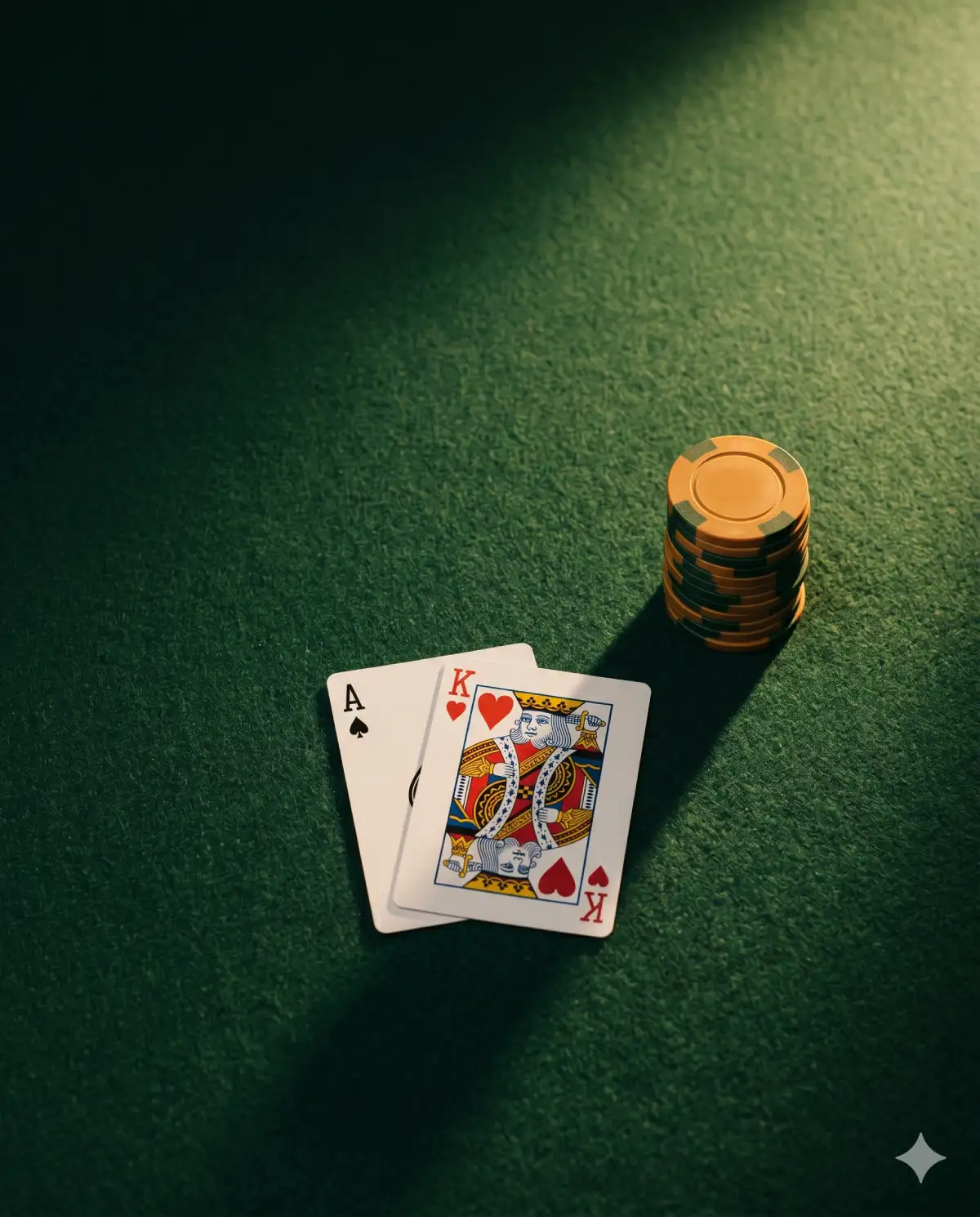
When you get blackjack (an Ace + a 10-value card), the standard payout is 3:2. A €10 bet pays €15. In some variants — both online and in physical Vegas-strip casinos — the payout drops to 6:5. A €10 bet pays only €12.
This small-looking change adds approximately 1.39% to the house edge. A blackjack table that pays 6:5 has a house edge close to 2%, even with perfect basic strategy — that is four times worse than a 3:2 table.
Always check the payout rule before sitting down. If the table pays 6:5, walk away and find another.
Live dealer vs virtual blackjack
Virtual blackjack uses an RNG that shuffles the deck before each hand — card counting is impossible because the shoe effectively contains infinite decks from a strategic standpoint.
Live dealer blackjack uses physical cards from a real shoe, typically 6-8 decks reshuffled around the 50% penetration point. In theory this creates a tiny window for advanced techniques (card counting), but operators monitor for it and the stream lag makes it impractical.
For most players, virtual blackjack is fine. Live dealer blackjack is a better experience socially but does not meaningfully improve your expected value if you follow basic strategy.
Practical recommendations
Learn basic strategy before playing for real money. 30 minutes is enough to memorise the most important decisions; a full chart reference covers the rest.
Insist on 3:2 blackjack payouts. Walk away from 6:5 tables.
Never take insurance. It is a bad bet mathematically, regardless of what the dealer shows.
Classic or European blackjack are the best default choices. Exotic variants (Spanish 21, Switch, Perfect Pairs) are fine for variety but always recalculate the strategy.
Ready to play blackjack?
Start with an operator we have verified holds a top-tier European licence.
Ad · Affiliate link · +18 · T&C apply